Sunday, October 21, 2012

A Dynamic and Productive Soccer Sideline?

Converting Potential Energy into Electrical Energy!

I have spent many hours driving to and watching our daughter's soccer games.  These are something I look forward to as it gets me out of the house even on cold and rainy days.

But these trips come with a bit of a guilt trip.  I fret about the many miles we drive and the gas we burn as hundreds of families descend on these soccer fields.  Also folks bring a folding chair and promptly plop it down on the sidelines, and then sit and shout for the whole game while encouraging kids to run faster and play harder.

Potential Energy ready for harvesting!

Would it not be great if there was a row of stationary bikes on the sidelines that were plugged into a device that could generate electricity and possibly even push it into the grid?  Yes, yes I know the amount of energy generated by a stationary bike is minuscule but there are hundreds of people sitting on the sidelines.  Plus imagine the side benefits.  The folks would get some exercise, and possibly be too out of breath to curse at the referee.  The kids would be thrilled not to have their parents shouting at them.

Think this is impractical?  Seems there are several devices like this in the market that can be plugged into regular bikes with the rear wheel raised on a stand to make them into stationary bikes.
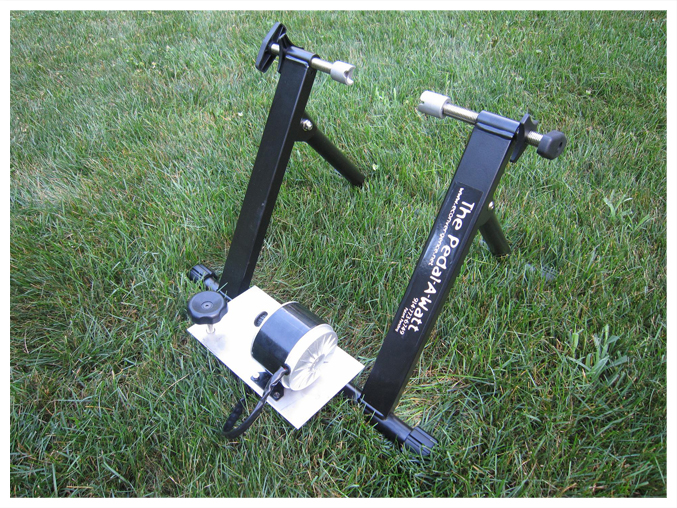


"Nah none would use it!" you say.  Well how about giving them some motivation.
We could pit parents of the two sides against each other and even have a power meter indicating which side is generating more power.  Thus while the kids play peacefully in the middle, parents can duke it out constructively on the sidelines.

What if the soccer facility provided the bikes and parents would swipe an ID to register themselves and their energy production could be tracked and they would get back some credit?  This system already has been imagined for bike rental systems here.

Any takers?


Saturday, October 20, 2012

Infographics: Can they make reading journals easier?

As we struggle with information overload and clinical overload, it is harder to keep up with updates in medical literature.  Several journals are trying to make it easier to scan articles and get the salient points quickly e.g. Annals of Internal Medicine provides a commentary summarizing the practical implications of a study.
My assumption is that most readers scan the abstracts of articles before deciding which ones to read in full.  Appropriate use of graphics can improve comprehension and possibly make this scanning process more efficient.  As the old saying goes "A picture is worth a thousand words".  Clearly graphics are very popular as can be seen by the popularity of Infographics and Pinterest.
So I decided to try out a free infographic creation tool Piktochart to create a visual representation of the salient points of a study.

I chose this study from JAMA - because it was the first study that caught my eye in my Google Reader stream after I thought of this idea.  So this is what the abstract looks like:


As you can imagine it took me a few minutes to get the main message of the study.  What if I had seen this infographic instead?  I took all the information from the study abstract.  The only thing I added was the Number Needed to Treat (NNT) that I calculated myself.  
Infographic Created by Neil Mehta
So what do you think?  Does an Infographic make it easier to scan journal articles?  If so, should journals have data visualization experts on their editorial team to help create these?  Should there be standards for creating these e.g. Blue circles for control groups and yellow for intervention groups, etc?


Friday, October 19, 2012

The Search Hub - search the Web, Email, Cloud storage and Bookmarks from one place!

We know how Google transformed how we find information.  It is the default search engine for majority of users.  But many users may not be aware of 2 features that help me tremendously.


  1. Google is now doing a field trial that lets you search your Gmail and Google Drive for the search terms
  2. When you search using Google it can simultaneously search your Diigo Bookmarks.  
So now you can from one hub search the web, your email, your cloud storage and your bookmarks!  

Google Search Field Trial - search Gmail and Google Drive from Google Search!

Search your Diigo Bookmarks from Google Search.