Showing posts with label Social media. Show all posts

Saturday, April 30, 2016

Lotus in the Mud: Lessons for Happiness in Social Media

Via Abraham Morales on Flickr

This was a pretty crazy week on Social Media with posts running the gamut from shocking and depressing to good-natured fun to "feel-good" and uplifting.  Just as I felt myself feeling dragged down by the online cruelty and hate I found some fun and beautiful posts that brought hope and happiness.

A lot has been written about the potential of social media for learning and education but the fear that one slip can become a huge career-changing faux pas puts many caveats on this potential.  The perceived anonymity, the endless seeking of superficial likes and retweets and viral nature of the medium, have contributed to the rise of a culture of mobs and bullying by hordes.

The week started with a post on NY Times about the YouTube video of two female sports journalists who fought back against their harassers. The only way to be able to watch even part of the video was by thinking about the courage of these two amazing people and ignoring the mindless, hateful comments.

And then the terrible story of a young man in a NFL draft (the lottery for a lucky few who survive the unpaid commercial exploitation that is NCAA football).  While I don't know anything about this particular person - his skills, his character, his background - the story was gut-wrenching.  Someone apparently got access to his Twitter account and posted a video of him smoking cannabis via a "Bong" device, which is something like a hookah.  This was done just before the draft and led to several teams skipping him and choosing someone else.  While there are many perspectives on this, the episode captures the hate, jealousy and power of the medium and the huge risks it brings.

But as the week went on, there was something better - this story via Buzzfeed.  An embarrassing photo of a firefighters rescuing a group of police officers stuck in an elevator.  Apparently 12 tactical team officers got on an elevator - they exceeded the weight limit- and the elevator got stuck.  The firefighters before they rescued them took a photo and there was some good-natured banter back and forth on Twitter.
Image via @Gregg Favre  
And this morning I woke up this post from the POTUS and FLOTUS helping Prince Harry increase awareness of the Invictus Games which uses the power of rehab sports to help injured servicemen/women in the road to recovery.


It was great to see these last two posts because in a big way they helped overcome the negative feelings generated by the first two.  The positive feeling helped restore faith that the medium can be used for good and fun.
While  we have read about studies regarding mood disorders and depression caused by Facebook it is good to think about the key factors in happiness:

  1. Good social relationships (belonging)
  2. Spending a part of your day doing things that you are good at and passionate about (mastery) and
  3. Having autonomy and freedom to make life decisions (autonomy)
 - and this excellent piece in The Atlantic shared by Eric Warm  on Twitter helped start off the weekend.  The article summarizes an interview with Raj Raghunathan the author of "If you are so smart why aren't you happy?"  He advocates for the Abundance-minded approach to life vs. the Scarcity-minded approach, 
"One extreme is a kind of scarcity-minded approach, that my win is going to come at somebody else's loss, which makes you engage in social comparisons. And the other view is what I would call a more abundance-oriented approach, that there's room for everybody to grow".


He then goes on to talk about the dispassionate pursuit of passion,
"...basically the concept boils down to not tethering your happiness to the achievement of outcomes"
"Ultimately, what we need in order to be happy is at some level pretty simple. It requires doing something that you find meaningful, that you can kind of get lost in on a daily basis". 
To cap it all was the terrific NPR story of students reporting on their teacher -  and the most important rule of her class - BE KIND!

Hope the Twitterverse is listening to her!

Saturday, April 25, 2015

A Personal Learning Network becomes a Print Journal Issue: Why Academics Really use Twitter

Social Media allows a motivated and engaged learner to build connections that can enhance lifelong learning.  The connections become a learners Personal Learning Network or PLN.  The ability of social media to help a learner find and connect with the right people that might be otherwise impossible to "meet" in real life is one of its huge potential advantages.

This can be a difficult concept to convey to someone who may have a very negative attitude of Twitter.  One can hardly blame them for thinking that Twitter is a time waster, that there is a huge noise to signal ratio with very little tangible benefit.

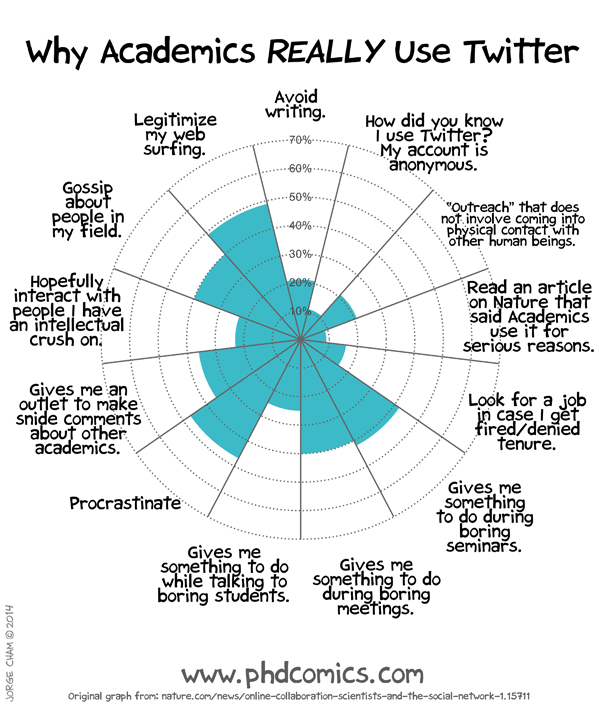
A famous Nature study showed that very few academics use Twitter compared to sites like Google Scholar.  This led to a spoof by PhD Comics on "Why Academics Really use Twitter".  This is quite funny maybe because it has an element of truth for those who use Twitter.  At the same time infographics like this might unintentionally dissuade people from trying out Twitter as it may reinforce their beliefs about its lack of usefulness.

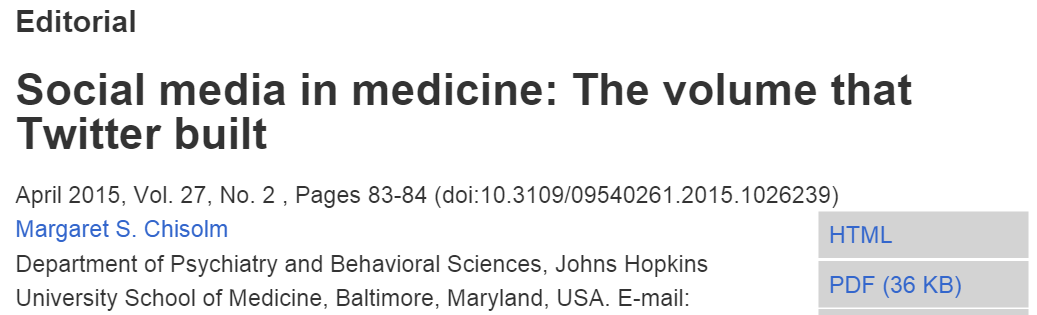
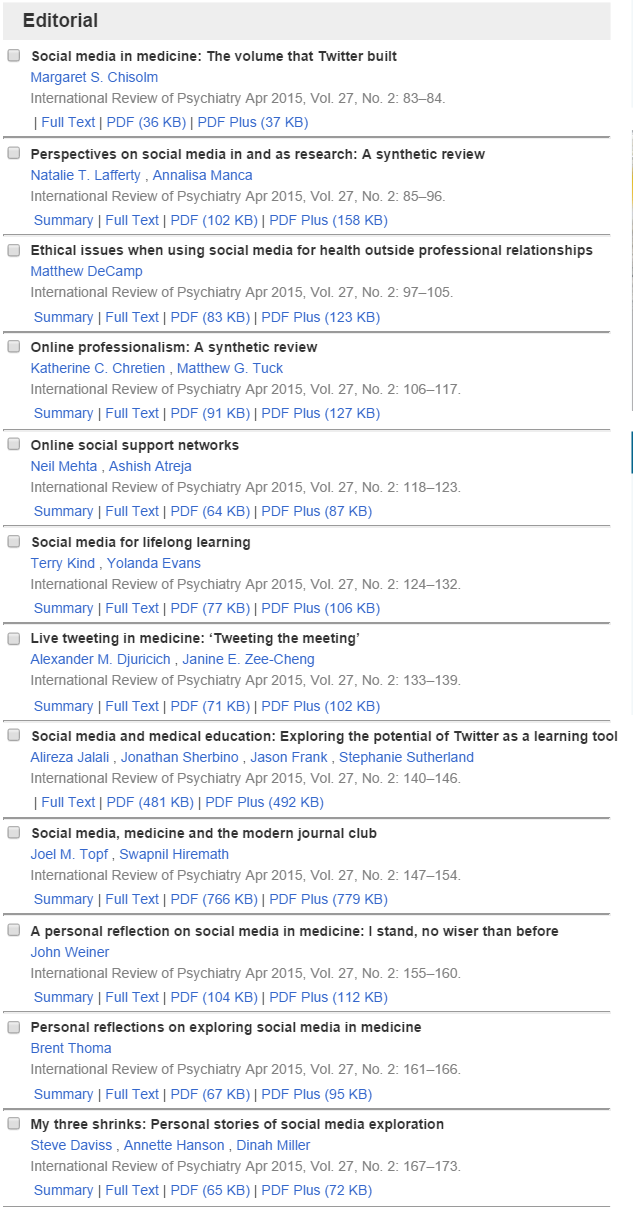
Now we have a great example of how a PLN created on Twitter led to an entire issue of a print journal.  The credit goes to Margaret Chisholm who was the editor of the special issue of "International Review of Psychiatry" and put together the issue with the help of a group of authors who mostly got to know each other first on Twitter and are part of a large PLN of health care social media users.


Granted, the special issue was regarding the use of Social Media but it could well have been any other topic in biomedical sciences where the scientists engage in social media.  This special issue of a print journal may be an excellent showpiece of the huge potential benefit of social media for academics - to create a PLN for lifelong learning.


Sunday, February 23, 2014

The Social Media Fire Hose Waters Down Discussions - Does Education Need Its Own Acamedia?

I love the ability of social media to let me build my personal learning network (PLN) and engage in discussions with people with similar interests.  But social media can be frustrating and as more people join and flood it with content, it is but natural that not everyone would be there for those reasons.  Thus social media is also used for marketing, building an identity, customer service, etc.  As someone who often touts the various potential uses of social media for learning and education, I wonder about the best way to prevent new adopters from getting disillusioned.

A case in point: People very often share links to content that they have not read

This tweet by Tony Haile (CEO of Chartbeat) sparked a series of posts in the blogosphere [The Verge][Small Business Trends]

This "unread" sharing maybe for many reasons - e.g. The title was funny, or the content was shared to someone who might read it, etc.  In the real world a share would be similar to a recommendation; it should mean something like, "I read this, found it worth reading and so am sharing it".  When you print out an article and leave it in a colleagues inbox with a sticky note, the recipient would assume you had read it.  If you had not, you would state something to that effect on that note, e.g. "Not my cup of tea but I thought you would find this interesting".  

It seems sharing on social media might be evolving into something different; we knew before Tony Haile's tweet that people may not have read something they shared.  In addition, there is less of an expectation of a rich discussion when sharing.  Some of this is specific to the platform.  

Thus Facebook is becoming limited to social sharing among friends and family (e.g notable and not so notable life events) and anything intellectual or cognitively stimulating can get frowned upon.  For example a resident recently posted an abstract of her paper that was published in a prestigious journal on FB.  She had to preface this with an apology for a "nerdy post".  There were over 40 likes and "Congrats" but not one question about the abstract or the implications of the study.  Most of the folks who commented were in the medical field.  This is not to criticize the author of the post or her friends, but more a reflection on the culture of the platform.  
The purpose of the interaction appears to be to acknowledge that you saw the post; it is more of a head nod or a high-five rather than an intellectual discussion, an opportunity to truly engage and learn in the process.  

Twitter is a truly terrific platform but the 140 character limit poses a barrier to rich discussions.  The unfiltered timeline moves at a disconcerting pace and can be distracting for some.  Tweetchat sessions can be great for group discussions but take some getting used to.  For some there can be a need to increase follower numbers as can be judged by the many how-to articles describing strategies to do this.  This can lead to retweeting posts by "celetweeps", using multiple trending hashtags and similar methods to try and gain attention.  There are other reasons why it may be difficult to have discussions on Twitter. Many people use sharing tools integrated within the website that they are looking at or use a scheduling service like Buffer.  Thus they share to Twitter but are not actually using the Twitter interface.  They may not see your response till much later.

Recently a physician tweeted a link to a nice study that calculated the number needed to treat for most common treatments for a common condition.  The article was behind a paywall and the abstract did not mention what outcome measure was used to calculate NNT.  This was not a condition that would lead to hospital admissions or death and thus did not have a well-known or guessable outcome measure. I replied to the tweet asking for this information but got no response.  There could be many good reasons for this in this particular case and it is interesting that it did not surprise me too much.   In RL if someone gave you a paper to read, one would expect that he or she would take the time to respond to a question you had.  Unfortunately on Twitter people are "giving out" tens of papers to hundreds and thousands of followers which removes the expectation of responding to all the questions.  

The norm it seems is, "I just shared that with you and the whole world. Don't expect me to be to engage in a discussion on it or to have even read it deeply."  
The Verge article cited above discusses that there are folks who do read the entire article before sharing.  The concern is that it is difficult to separate the two.  Those of use who have used social media for a while have a somewhat robust PLN and continue to grow it.  Twitter is actually a great place to find people with similar interest to build your PLN.  But for recent digital immigrants, the experience can be quite disappointing.

As educators we have seen the potential of social media to create and build PLNs, for lifelong learning, for online journal clubs, for communities of practice and communities of inquiry.  This potential is still there but we may never fully realize it if the culture of the platforms is diametrically opposite to this philosophy.    

So what is the answer?
  • Back to blogging? - unfortunately one would have to post on Twitter to get people back to Blogger to discuss the post.  The problem is folks will retweet without ever visiting the blog!
  • Use Google+ - the ability to create very granular circles for viewing and sharing and lack of character limits are huge plusses!  An additional benefit is the integration of Blogger with Google+ that prevents fragmentation of the conversation
  • Use filters e.g. Lists on Twitter to engage with people who are interested in discussion?
How about Twitter adding a check box, "I have read this"?  It would be a box that would pop up anytime you add a hyperlink or retweet a post that has an embedded hyperlink.  Checking the box would indicate that you are also interested in a discussion on the topic and it is not just a FYI post.

The interface could look something like this:


What do you think?  Maybe social media is just mirroring or even magnifying real life?  Maybe social media was meant to be just that - social, and academia needs to get with it and build its own platform for professional media - maybe call it acamedia?  

Maybe social media is teaching us a real-life lesson - it is not simple to build your PLNs - it is a process that one has to go through and Twitter is a great learning lab to learn this process?


Saturday, September 14, 2013

Top 5 Reasons Why Educators Should Learn About Social Media

Just this morning I saw an excellent SlideShare presentation by +Jennifer Legarde that was shared by +Linda Lindsay on Google+.  The theme of the narrative is about making sure that curriculum and pedagogy are considered before choosing technology to enhance learning.


I loved the presentation as I often begin my presentations with a quote like, "Content is King" or "Pedagogy eats technology for lunch".  This slide deck is replete with great quotes that I have used or will quite likely use myself.  Alvin Toffler's gem on Slide 54 hangs on my office wall.  

The message for the the technophile is to look before you leap and remember that technology is only a tool.  On the flip side, there are many educators who are either waiting for evidence that technology actually enhances learning, or late adopters, or technophobes or anxious or uncomfortable about or too busy to learn new tools.  There may be many possibly valid reasons for an educator to keep doing what "works" for him or her.  But there education is all about curiosity, about simulating, motivating and exploring.  So educators of all people should be eager to learn about new methods, tools and techniques.  

Social Media is an amazing force that allows for creativity and collaboration.  If educators are still wondering about the need to learn about this medium, here are 5 top reasons to wait no more!

Top 5 Reasons Educators Need to Use Social Media

Sure there are potential hazards to using social media but only by exploring these tools can educators get comfortable with them and help guide their learners in making the most of these in a safe manner.


Saturday, December 1, 2012

Why don't we see patients in our pajamas?

Professional identity and social media are being hotly debated ever since the rise of Facebook.  The topic raises questions about how physicians should  behave on social media.

The fact is that social media is bringing to the forefront something that has been around for ever.  Lets look at some of the background literature on this.

Goffman in 1967 wrote in the "Interaction Ritual - Essays on Face-to-Face Behaviour;
"Every person lives in a world of social encounters, involving him either in face-to-face or mediated contact with other participants.  In each of these, he tends to act out .... a pattern of verbal and nonverbal acts by which he expresses his view of the situation and through this his evaluation of the participants, especially himself. Regardless of intent, he will find that he has done so in effect.  The other participants will assume that he has more or less willfully taken a stand, so that if he is to deal with their response to him, he must take into consideration the impression they have possibly formed of him."
"When an individual appears in the presence of others, there will usually be some reason for him to mobilize his activity so that it will convey an impression to others which it is in his interests to convey"
Schlenker wrote about Impression Management and self-presentation:
 "Impression management is the goal-directed activity of controlling or regulating information in order to influence the impressions formed by an audience.  When people are trying to control impressions of themselves, as opposed to other people or entities, the activity is called self-presentation."
Schlenker goes on to discuss that self-presentation does not have to be Machiavellian or purely there for self-advancement or self-prormotion.
"Self-presentation is a fundamental feature or characteristic of interpersonal experience.  It is inconceivable to discuss human social behavior without employing the concept.... we package information to help audiences draw the right conclusion.  This packaging is a pervasive feature of interpersonal behavior."
One must be aware of how people are perceiving and responding to our self-presentation so that we can deliver the package to meet the appropriate goal - something that does not have to be deceptive or immoral.  It may take as much social skill to create an accurate self-presentation as a misleading one.

This fact has been highlighted by the popular press with books like, "How to win friends and influence people" and "Getting to yes".  Social media has truly brought this home into every minute of our awake state.

Sherry Turkle in her NY Times op-ed talks wistfully about the loss of conversation for mere connection.
"Texting and e-mail and posting let us present the self we want to be.  This means we can edit.  And if we wish to, we can delete.  Or retouch: the voice, the flesh, the face, the body.  Not too much, not too little - just right.
She laments how we are getting comfortable with the intrusion of technology into "real" life
"We expect more from technology and less from one another...We use technology to define ourselves by sharing our thoughts and feelings as we're having them.  
Nathan Jurgenson has coined the term "Digital Dualism" for this separation between online and offline and calls it a fallacy.
"Instead, I want to argue that the digital and physical are increasingly meshed, and want to call this opposite perspective that implodes atoms and bits rather than holding them conceptually separate augmented reality."
And in the Atlantic he writes,
"Emile Zola stated back in 1901, 'You cannot claim to have really seen something until you have photographed it.'  Today, we joke, 'It did not happen unless it is posted on Facebook.  Photography caused a global sensation around the new possibility: to document ourselves and our world in new ways, in greater detail and in lasting permanence."  
Just as photographers who may not be able to look at a scene without imagining how it would look through a camera's viewfinder, today's digital native may perceive "reality" by how it could be posted on Facebook.  Our parents took photographs on vacation trips and did looooong presentations at dinner parties with Kodachrome slides!  We now take photos with our smartphones and post these instantly on social networking sites.

But every time we do this, we are doing impression management and more specifically self-presentation.  We are constantly creating, modifying and managing our identity in the social networking space.  We are consciously or subconsciously aware of our environment and our perceived audience and have have an impression of how they perceive us and how each share in the social space affects that perception.

This again is just an extension of our life as usual.  Physicians wear a white coat and/or a tie or other appropriate clothing when they see patients.  Why don't they wear their pajamas?  There is a perception of what patients think a physician should be wearing.  This has been drilled into us often subliminally as we go through medical schools and residency training.  It may be difficult to break out of that mold.
But we dress differently when we go to watch a football game or to the grocery store.  Thus physicians clearly have a sense of self-presentation for different environments and perceived audiences.

So why do we have all these cases of unprofessional conduct in social media?

Firstly the problem in case of new entrants to the profession might be due to them not recognizing that the rules of engagement are now different.  Some of the folks who saw them as a college kid now might expect to see them as a future doctor.  But more importantly they now may have a new audience that perceives them only as a future doctor.  This is a problem if they have not locked down their social media profile and thus may be visible to the public.

Secondly, any person can make a slip and in a momentary lapse forget to don his social media white coat when interacting on a public forum.

I would suppose that when there is a wide gap between the baseline persona and the self-presentation situation, a person would find that environment more stressful and if not careful, is more likely to commit a bigger lapse of professionalism.

This leads to a question of why can a person not be "himself" (if there is such a thing), instead of having to don all these different personas?  I guess one should study mindfulness or Engaged Buddhism where Thich (Thay) Nhat Hahn preaches how to be truly happy,

"To be beautiful means to be yourself. You don’t need to be accepted by others. You need to accept yourself. When you are born a lotus flower, be a beautiful lotus flower, don’t try to be a magnolia flower. If you crave acceptance and recognition and try to change yourself to fit what other people want you to be, you will suffer all your life. True happiness and true power lie in understanding yourself, accepting yourself, having confidence in yourself."

Tuesday, May 1, 2012

Challenges in doing Social Media Workshops for Medical Educators

In the last 2 weeks, I have had the privilege to be invited to do presentations on use of Social Media in Medical Education at 3 different places.  It is exciting to see the growing interest levels in social media in medical academia.  There is a buzz in the air at these events which is quite refreshing.

Each of these was a large group presentation to an unfamiliar audience.

Sitting at the airport waiting for a flight back home from the last one of these, here are some reflections:
  • Presenting when you don't know your audience's level of expertise with the topic is always challenging.
    • Use Google Moderator if possible to get some idea of what the audience would like to see.  This is a great tool do a needs assessment and also weave a social activity into the hidden curriculum.
  • Find out as early as possible about Internet access at the site.  Will the audience have Internet access?  Is it a public WiFi or is a password or some other security measure required?
    • If you require your audience to go online project a slide with appropriate instructions before your presentation.  
  • If you need the audience to download an app or create an account, ideally you want to send these instructions out by e-mail well ahead of time.  Thus if you want to do a demo of a Twitter chat you may want them to create a Twitter account ahead of time and remind them to remember the password.  
    • Expect a significant portion of the audience not to have followed up on those instructions. There could be many good reasons for this, e.g. did not want to create a Twitter account due to privacy concerns. Or they are in a different stage in Kolb's learning cycle (more on this below).  Say something to prevent chaos (e.g. "how do I get connected?" or "I never got the instructions!" or "I am worried about creating a public profile").  Say something like, "How many have created a Twitter account? That's great, we have enough participants for a good demo.  Those who have not, will be able to watch the exercise as we will project it on the screen.  Those who did, please follow the instructions in your handout (or on the screen) to get started. 
  • One of the best ways to think about the audience participation is to review Kolb's learning cycle.  According to Kolb, when people learn new things, they either want to watch and think OR feel and do.  This is a bit of a simplification and you can read more about this here.  Kolb has a learning style inventory that people can fill out and share with you so you can know ahead of time what their learning style is.  But that is a long questionnaire and is not free.
    I wonder if one could pair up an Assimilator (watch-think) person with an Accomodator (feel-do) person and have them work together through the exercises?  
  • Somehow we also have to account for the participants' digital competence.  Ideally you could create small groups which include at least one computer expert and one Accomodator.  
  • The auditorium/room where you are presenting might preclude working in small groups.  
  • All you can do is cross your fingers and toes and hope for the best!  Just try and light the fire and leave them with resources to go back to.  I tell the audience to find a social media mentor at their local institutions who can get them started.

Friday, April 27, 2012

Will Medical Educators Adopt Social Media?

This morning I had the privilege to do a presentation on the use of Social Media in Medical Education to a group of seasoned medical educators.  David Pilasky, Jason Korenkiewicz and Nicholas Arcieri made up the rest of the presentation team.  This was a group well versed in pedagogy and the changing landscape of healthcare in the country.  But they were mostly unfamiliar with possible pedagogic uses of tools like Tweetchats and Google Hangouts.
We did a pre and post session poll to gauge the knowledge of and attitudes towards use of Social Media in Medical Education.

Here is a storify summary of the session.  It is impressive to see the gradual change in the audience as the session went on.

23 minutes ago · 1 views
  • 52

The MedEd Plenary on Social Media

An introductory session on the use of Social Media in Medical Education - participants included people involved in various aspects of medical student education and were mostly new to Twitter.
  1. Asked the audience about their reaction to Twitter. Tweet's captured the response from the audience! (Not the poster's opinion)
  2. Share
    First reaction on the use of Twitter. "Ugh" #someded
  3. Share
    #someded Why people don't use twitter? Get off my lawn, too busy.
  4. The audience slowly began to thaw 
  5. Share
    Educators beginning to see the use of social media. @Neil_Mehta is on fire! #someded
  6. Share
    Knowledge is about to be disseminated, loving it! #someded
  7. Share
    Love it! @dsmwiener: #someded About to learn more about social media from Neil Mehta
  8. Gave a very very brief demo of how to use Twitter with #Someded hashtag.  There were a few tentative first tweets!
  9. Share
    #someded Hello everyone. This is my first tweet ever!


    12 hours ago
  10. Share
    #someded


    12 hours ago
  11. Share
    #someded hello


    12 hours ago
  12. Share
    #someded hello everyone

    12 hours ago
  13. Share
    #someded I finally got through!

    12 hours ago
  14. Nicholas Arcieri did a great job encouraging the users.
  15. Share
    Don't be afraid of Twitter, it can't bite, I promise! #someded
  16. Share
    everyone is doing a great job for their first time tweeting! #someded
  17. We started off with a demonstration of a case discussion on Twitter
  18. Share
    We have a 50-year old male with low back pain #someded
  19. Share
    From CWRU: Does he have bladder or bowel incontinence? #someded
  20. Share
    History of cancer? #someded
  21. Share
    @KorenkiewiczJ great question... no cancer, no incontienece #someded
  22. We got some questions about the typical red flags.  Prompted the audience for more questions and got some great ones.
  23. Share
    Any other questions? before we proceed to exam #someded
  24. Share
    Does he have fever or chills? #someded
  25. Share
    #someded does he have insurance?

    12 hours ago


  1. Any other symptoms? #someded
  2. Share
    #someded what is height and weight
  3. There was a great response from the group, they start seeing the potential and start thinking of potential applications.
  4. Share
    How do medical educators use social media? @Neil_Mehta uses tweet chat w/ students. #SoMedEd

    ReplyRetweet12 hours ago
  5. Share
    <- chat room on steriods #someded

    12 hours ago
  6. Share
    #someded Very cool!

    12 hours ago
  7. Share
    Hi! This may have promise! #someded


    12 hours ago
  8. Share
    #someded multiple uses in med ed


    12 hours ago
  9. Share
    #someded we are getting there


    12 hours ago
  10. Share
    #someded could use this to chat with incoming students.

    11 hours ago
  11. Share
    #someded A great advantage is connecting with people you don't normally get to collaborate with!

    11 hours ago
  12. Share
    #someded grouptweet.com for private conversations
  13. Share
    #someded @Colleenocg Twitter and Twitter fountain could be useful for use in Group Application Exercises within TBL


    11 hours ago
  14. Share
    Storify sounds like it has a lot of potential... #someded


    11 hours ago
  15. The conversation was picked up by folks outside the meeting
  16. Share
    RT @UCPritzker: How do medical educators use social media? @Neil_Mehta uses tweet chat w/ students. #SoMedEd
  17. Share
    RT @UCPritzker: How do medical educators use social media? @Neil_Mehta uses tweet chat w/ students. #SoMedEd
  18. Share
    RT @UCPritzker: How do medical educators use social media? @Neil_Mehta uses tweet chat w/ students. #SoMedEd
  19. Share
    RT @UCPritzker: How do medical educators use social media? @Neil_Mehta uses tweet chat w/ students. #SoMedEd
  20. Some concerns, some anxiety, barriers and some great humor!
  21. Share
    #someded I'm going to start just printing the Internet


    11 hours ago
  22. Share
    #someded Very informative article. Glossary makes me realize how little I know.

    11 hours ago
  23. Share
    #someded This seems complicated for widespread faculty use


    11 hours ago
  24. Share
    I am a novice in learning a new skill #someded

    11 hours ago
  25. Share
    #someded we need tutors/mentors


    11 hours ago
  1. Many concerns about identity authenticity & management #someded
  2. Share
    #someded iPad interface is not great


    11 hours ago
  3. Share
    #someded that's it! I'm going back to stamps!
  4. Some feedback; Some Tips and resources
  5. Share
    #someded Well worth the time. 

    11 hours ago

  6. Share
    IT session was user friendly and fun--CWRU was outstanding! #someded


    11 hours ago
  7. Share


    Great time talking to student services, very good questions. #Someded
  8. Share
    The article is very informative as I knew nothing about this new thing #someded


    11 hours ago
  9. Share
    RT @PeterMMarzuk: #someded thanks to all our friends from case for a great meeting


    11 hours ago
  10. Share
    You can follow people in this feed by putting the mouse over their name and the follow button should pop up, then just click follow #someded
  11. Share
    RT @nicholas_urmc: Here is a great guide on #GettingStartedWithTwitter paulpduxbury.com/HowToTwit...#someded
  12. Share
    RT @nicholas_urmc: You should take your IT guy to lunch and make him tell you all of the twitter secrets.... #someded
  13. We did a pre and post session ARS poll which showed an impressive change in knowledge and intention to change behavior (use SoMe in teaching).  This was a terrific audience - who says medical educators can't be open minded about change!


What about the pre and post data?  Well we did not do an IRB for this study so would not be able to reveal that results ;-(